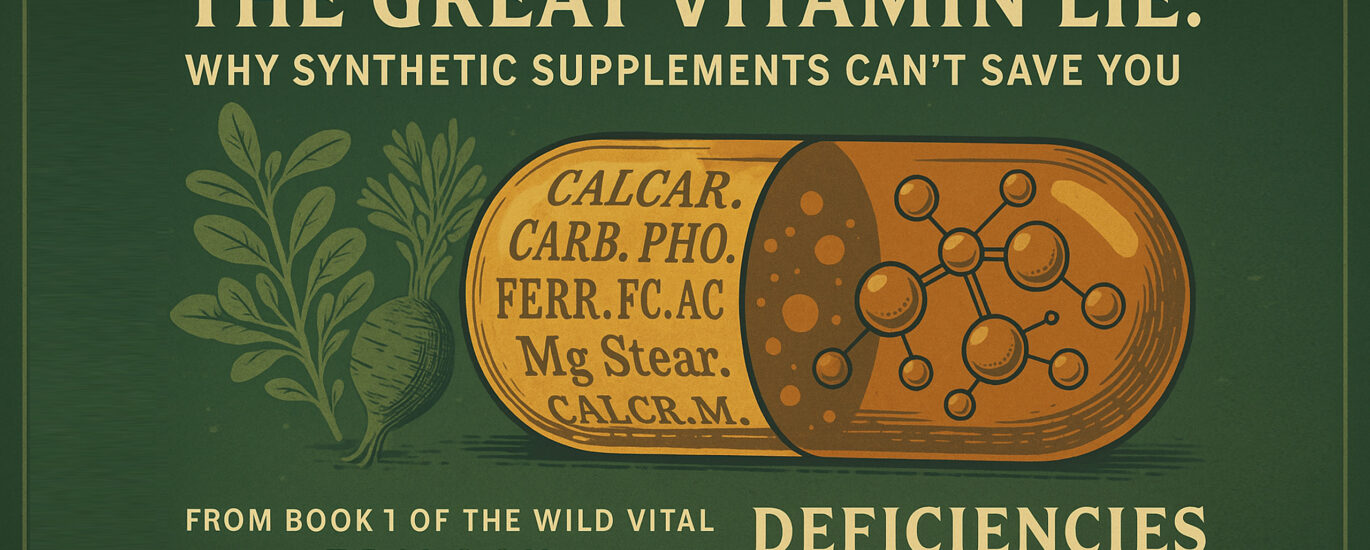
The Great Vitamin Lie: Why Synthetic Supplements Can’t Save You
From Book 1 of the Wild Vital Trilogy: Deficiencies – What They Didn’t Teach Your Doctor
You’re tired. You’re foggy. You’re inflamed.
You want to feel better.
So you do what you’ve been told:
You go to the health food store and grab a bottle of “high potency” vitamins.
A week later, nothing’s changed — or worse, you feel even more off.
This isn’t a failure of nutrition.
This is a failure of synthetic nutrition — and it’s time to stop blaming your body for what your supplements can’t deliver.
🧪 What You’re Taking Isn’t Nutrition — It’s Chemistry
Most over-the-counter vitamins — even those sold in expensive wellness stores — are lab-manufactured fragments. They are isolated compounds, often derived from petroleum, coal tar, or genetically modified corn syrup, then mixed with binders, flow agents, and stabilizers.
They are not:
- Complete nutrients
- Naturally occurring forms
- Accompanied by the necessary cofactors your body needs to actually use them
Take Vitamin C, for example. Most supplements contain only ascorbic acid — just the antioxidant shell of the real vitamin C complex. Missing are:
- Rutin
- Tyrosinase
- Bioflavonoids
- Mineral transporters
- Enzymes
Without these, ascorbic acid becomes an aggressive compound your body has to buffer, detox, and regulate. That buffering pulls minerals like calcium and magnesium out of storage — causing further imbalance.
🧬 Nutrition Isn’t a Single Ingredient — It’s a Network
In wild food, vitamins and minerals never occur alone. They exist in an orchestra — a living, interacting matrix.
For example:
- Magnesium works with vitamin B6, taurine, and potassium to relax muscles and nerves.
- Vitamin D requires magnesium and vitamin K2 to avoid calcification.
- Zinc without copper creates a neurological crash.
- Folate without B12 can cause neurological symptoms instead of fixing them.
Isolated vitamins?
They play out of tune — or not at all.
⚠️ Synthetic “Nutrition” Can Become Toxic
What happens when you put incomplete, synthetic nutrients into an already nutrient-deficient, inflamed body?
You don’t nourish. You burden.
Your liver, kidneys, and lymphatic system — already overwhelmed by environmental pollutants — now have to detox the very thing you took to “get healthy.”
Symptoms can include:
- Headaches
- Fatigue
- Insomnia
- Anxiety
- Bloating
- Skin rashes
- Hormonal dysregulation
And when the synthetic nutrients aren’t absorbed or used properly, they accumulate in tissues or are excreted unchanged, offering no benefit — and sometimes, collateral damage.
🥄 The Dose Deception
Even if synthetic vitamins did work perfectly (they don’t), most supplements are dosed so low they can’t make a difference — especially if you’re already depleted.
For example:
Your body requires 4,700 mg of potassium per day to regulate heart rhythm, blood pressure, nerves, and muscle contractions.
The average potassium supplement?
Just 99 mg per pill — due to outdated FDA regulations from the 1970s.
To meet your needs, you’d need to take 47 capsules a day.
Meanwhile, a single serving of wild nettles, beet greens, or coconut water can deliver hundreds of mg, along with magnesium, vitamin C, and dozens of cofactors.
💥 The Trust Crisis
People try synthetic supplements, feel no change (or feel worse), and conclude:
“Nutrition doesn’t work.”
But that’s like testing cardboard and assuming food doesn’t nourish.
The problem isn’t nutrition — it’s dead, incomplete, chemically isolated fragments marketed as nutrition.
🌿 The Wild Vital Solution
Nature doesn’t make isolates.
It makes complexes. Webs. Ecosystems of nutrition designed for human biochemistry.
In Book 1 of the Wild Vital Trilogy, you’ll learn:
- The action of each essential nutrient in the body
- The symptoms and misdiagnoses that point to deficiency
- How to use wild plants, mineral-rich broths, organ meats, and food-based concentrates to replenish
- Which combinations of nutrients work in synergy
- How to restore your faith in nutrition by feeling it work — fast
You’ll also discover how wild foods like:
- Purslane (omega-3, magnesium, potassium)
- Pine pollen (B-complex, amino acids, natural hormones)
- Sprouted seeds (zinc, manganese, selenium)
- Raw dairy, fish roe, and pastured egg yolks
…contain more useable nutrition than entire aisles of lab-made supplements.
⚡ The Relief You’re Missing Is Closer Than You Think
Your body is not beyond help. It’s just been handed the wrong tools.
- Your brain isn’t broken — it may just need choline and glycine.
- Your thyroid isn’t “low” — it might need selenium, iodine, and tyrosine.
- Your mood swings may not be “mental illness” — they may be magnesium, B6, and vitamin E shortages.
Wild-sourced nutrients aren’t a trend — they’re how humans survived, healed, and thrived for millennia.
📘 Book 1: Deficiencies – What They Didn’t Teach Your Doctor
If you’ve lost trust in supplements…
If you’ve spent thousands on bottles and gotten nowhere…
If you’re ready to give your body what it actually needs, in the form it recognizes…
This book is for you.
Backed by science. Grounded in nature. Proven by results.