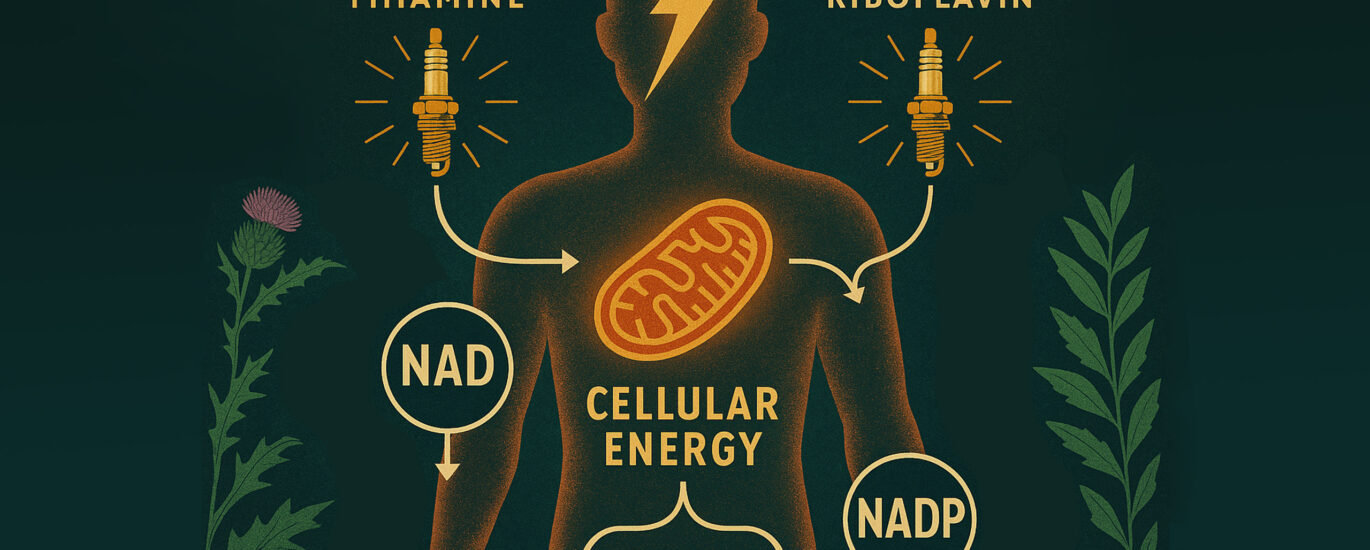
B1 and B2: The Shuttle Bus Spark Plugs That Drive Cellular Energy
Why You’re Still Tired, Even If You’re Eating “Healthy”
Most people never learn that your ability to produce and use energy at the cellular level depends heavily on two underrated vitamins: Vitamin B1 (Thiamine) and Vitamin B2 (Riboflavin). These aren’t just “energy vitamins” like supplement labels suggest—they are critical co-factors in a core cellular process called NAD/NADP cycling. If that cycle is disrupted or undernourished, your body literally can’t make or use energy properly, no matter how well you eat—or how many supplements you take (especially if they’re synthetic isolates of nutrient complexes that cannot do the job “out of network” without their full-spectrum complex).
This article breaks it down in plain language, helping you connect the dots between food, vitamins, and why your battery might feel drained even when you’re eating right.
What Is NAD/NADP and Why Does It Matter?
Let’s simplify this: Think of NAD (Nicotinamide Adenine Dinucleotide) and NADP (its phosphate version) as electron shuttle buses inside your cells. Their job is to carry energy (in the form of electrons) to and from the mitochondria—your cell’s power stations. When this process runs smoothly, energy is made efficiently. When it’s disrupted, it’s like trying to drive a car with no spark plugs—fuel is there, but it won’t ignite.
B1 and B2 are the spark plugs.
Vitamin B1 (Thiamine) helps convert glucose (sugar) into acetyl-CoA, the key fuel that enters the Krebs cycle (energy production).
Vitamin B2 (Riboflavin) is essential for creating FAD and FMN, which are like electrical sockets that plug NAD/NADP into the cycle so they can do their job.
Without B1 and B2, your food just sits there—it doesn’t get transformed into real energy. This is why many people with low B1/B2 feel tired, mentally foggy, or dizzy, even after eating a full meal.
Common Symptoms of B1/B2 Functional Deficiency
Even if your bloodwork looks “fine,” you may have a functional deficiency if nutrients aren’t reaching your cells in the form they need:
Fatigue after meals
Brain fog and forgetfulness
Muscle weakness
Dizziness upon standing
Sugar and caffeine cravings
Digestive sluggishness or bloating
These are signs your NAD/NADP cycle may be starving for support.
How Terrain-Based Healing Differs from Basic Supplementation
Most B-complex supplements contain isolated or synthetic versions of these vitamins that aren’t well absorbed. Wildcrafters takes a different route:
Our wildcrafted tinctures include roots, herbs, and barks rich in naturally bound B-vitamins.
These full-spectrum plant-based sources are bioavailable, meaning your body recognizes them and puts them to work—fast.
We do not isolate nutrients from their complex matrix, avoiding stress on your detox pathways.
When your body gets nutrients in the form it expects from nature, healing accelerates.
Energy Isn’t Just About Calories—It’s About Conversion
Calories don’t equal energy unless your mitochondria can process them through redox cycles like NAD/NADP.
Without Vitamin B1, glucose can’t enter the mitochondria efficiently.
Without Vitamin B2, NAD can’t be recharged into NADH, halting the energy relay.
When both are low, it’s like a broken battery charger. You may eat enough, but still feel chronically low.
Support the Cycle Naturally
Try Wildcrafters’ Bioavailable B-Energy Support Tincture, which offers:
Wild-harvested plant complexes rich in B1, B2, and their natural co-factors
Terrain-friendly, alcohol-based extraction to preserve potency
Synergistic herbs to support mitochondrial output and redox cycling
Combine this with guidance from our Wild Nutrient eBook to understand the bigger terrain picture.
Also explore our CDS Guide for oxygenation support, as oxygen and redox go hand in hand in energy production.
Conclusion: Reignite the Spark
Don’t let fatigue become your norm. Understand that real energy comes from what your body can use, not just what you eat. With proper B1 and B2 intake from wild, whole sources, your NAD/NADP cycle can light up again—and so can you.
Disclaimer: All information provided on this website and by its authors or associates is intended for informational, educational, and entertainment purposes only. This content does not constitute medical advice, diagnosis, or treatment and is not a substitute for consultation with a qualified healthcare provider. Always do your own research and consult a medical professional before beginning any new health regimen.